
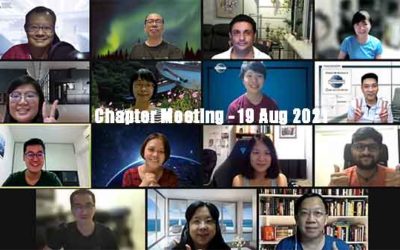
This was our third Combined Chapter Meeting of The Open Alumni Toastmasters Club and Telok Blangah Toastmasters Club for the term July 2021 to June 2022, held on 21 October 2021. Last month (September) we did not have usual Chapter Meeting but we held our Joint Club Evaluation and Table Topics Speech Contest with Telok Blangah Toastmasters Club.
Table of Contents
President’s Opening Address
Elaine reminded us that we have just another 2 more months before the year 2021 comes to an end. She asked us to take stock of the goals that we have set for this year. What are the projects that we have intended to complete but have not. She urged us to complete whatever projects that we have yet to prepare and complete as well as to sign up our monthly meeting roles before the year comes to an end.

Prepared Speeches
1st Speaker: Elaine Tan, ACB, CL, DL5
Pathway Project: Motivational Strategies, Level 1, Project 2, Evaluation & Feedback (2nd Speech)
Title: Why Am I So Happy?
Evaluator: Yoong Ee Chuan, ACB, CL, MS2
Elaine was presenting her the second speech of her Level 1 Project 2, Evaluation & Feedback. In this project, In this project, Elaine was supposed to reflect on the feedback given to her during her previous speech (19 Aug 2021 1st Prepared Speech), incorporate the suggestions given into her second (current) speech. The second speech can be the same as the first (previous) speech or a different speech.
Feedback and Suggestions From Previous Evaluator
In her current (second) speech, Elaine has chosen to use her same prepared speech, “Why Am I So Happy?” delivered during the 19 Aug 2021 Chapter Meeting. During that chapter meeting, Elaine’s evaluator, Wekie Tay, DTM, gave her the following feedback:
- Use a Point-Reason-Example-Point Structure including all the various highlights she had given in her speech
- Include more examples through various situations/illustrations in your life and help the audience apply your 3 points towards becoming even happier
- Pay attention to the differences between the elements of a research project versus that of a speech.
- 50% of the time was spent more on the introduction whereas the main points were rushed through.
- Towards the end, it was quotations after quotations without much time for elaboration.
- Smooth out the whole process in terms of arranging the content and wrap out with a sense of conclusion rather than to just end abruptly.

Implementation of Feedback Received
Incorporating the feedback given by her evaluator, Elaine did not carry out a survey with her audience during her second speech enabling her audience to focus on her speech instead of doing a survey. Elaine fired away with an introduction telling us that life is too short for us to be grouchy or grumpy. She has observed that many people around her are not happy.
She added the remark that she has known people who have not smiled for a continuous period of six months. in fact, for year. She quickly gave us her 3 secret recipes for being happy.
- You need to choose to be happy.
- Do not compare yourself with others.
- Do not be too hard on yourself.
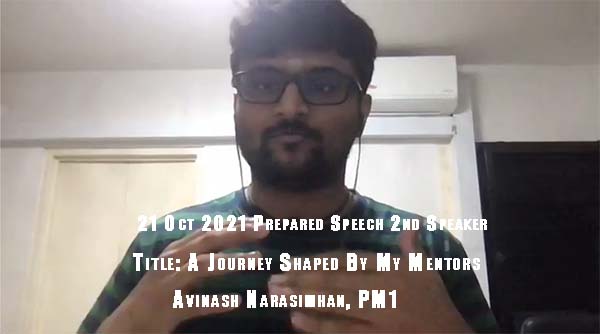
2nd Speaker: Avinash Narasimhan, PM1
Pathway Project: Presentation Mastery, Level 2, Project 3, Introduction To Toastmasters Mentoring
Title: A Journey Shaped By My Mentors
Evaluator: Wekie Tay, DTM
Introduction And Salutation
Avinash began by greeting us with a salutation in Sanskrit. He interpreted the salutation for us which meant, “Salutation to all the gurus in the winters in my life”. He said that he could not think of a more suitable statement to begin his speech. He told us that in the Indian culture, there is no other statement with a higher order of respect given to an individual. In the Indian culture, the parents come first, followed by the mentor or the teacher. Such was the respect that was accorded to parents and the mentors.
Mentors Back During Ancient Time In India
Avinash then shared with us what he learned from a book he read recently about the ancient Indian education system. Students would leave their parents at a very young age and began their journey in pursuit of knowledge.
Both mentors and mentees stayed together for a period of around 10 to 15 years. The guru or mentor imparted the knowledge to the mentees and the mentees served the mentor throughout this period doing daily chores. During this period, the students stayed entirely focused on the education and nothing else.
Avinash brought us back to the present and made a comparison. He strongly felt that in this age of distraction, such a system if implemented in the right way would be effective in imparting the right kind of wisdom to people. However, this is not feasible in reality. Thus, the alternative is to search for mentors in life.
Avinash’s Personal Mentors
Avinash continued by defining that a mentor is a person who is able to guide you towards your vision. He told us that he had a few mentors in his life and he mentioned two. The first was his mother and the other was a professor when he was an undergraduate.
My Mother, The Mentor Who Supported Me
Avinash related the incident where his teacher called his parents to school because he failed his Computer Science. His teacher told his mother that Avinash could not grasp the basic concept of the subject and thus was unfit to pursue a career in Computer Science. Avinash’s mother furiously retorted the teacher, “It is not the mistake of my son. It is basically the mistake of your teaching.” After defending Avinash, she challenged the teacher saying that Avinash would definitely be among the top five in the final examination.
This was exactly what Avinash was looking for in a mentor, the support from someone. He went on to secure 90% in his final examination and his career now is entirely related to software engineering. Avinash told us that his mother knew nothing about Computer Science, but she was the X Factor behind his success. Avinash believes that a mentor is to provide this X Factor.
My Professor, The Mentor That Revolutionise My Life Perspectives
Avinash’s second mentor was his professor in Environmental Science when he was an undergraduate. In Avinash’s opinion, this professor is an amazing person, full of wisdom and his knowledge in his domain is tremendous. He interlinked the sustainability and spirituality into the same curriculum and made his students understand the importance of the spiritual and moral values for protecting the environment.
This module was an eye opener for Avinash in his life. It gave him a totally new lens to view the world. He was also very interested in the conversation that he had with his professor who gave him a perspective of how to live his life in a different way.
In comparison, this was a totally different kind of mentorship from that which Avinash’s mother had given him, but under this mentorship made, Avinash began seeing the world in a different way. He has continued to keep in constant touch with this professor and they discuss many ideas including the concept of spirituality and its relevance in today’s world.
Conclusion
Avinash strongly believes that mentors have a way to shape our life for the better, and everyone must have a say in choosing their own mentor. It’s important to select the right person as your mentor and journey with them for a period.
3rd Speaker: Chay Wen Liang, DTM, VC4
Pathway Project: Visionary Communication, Level 5, Project 1, Develop Your Vision
Title: Learn For A Better You
Evaluator: Yoong Ee Chuan, ACB, CL, MS2
“Develop Your Vision” is a compulsory project in the Visionary Communication Pathway. The purpose of this project is to to develop a detailed vision for your personal life, professional life, or an organisation.
Formalised Learning Versus Self Education
Wen Liang began his speech by telling us that learning nowadays have changed from one where we have a teacher there to teach and guide you to one that you have to attempt learn on your own. In schools and amidst this pandemic, classes have gone online, and teachers need not necessarily be there at all time. In our working life as adults, we learn from the school of hard knocks where we fall and get up again on our own. Reflecting on these changes, Wen Liang felt that besides learning from our own experiences, there is still a need for formalized targeted learning to improve ourselves, not just about work, but also from a general aspect of our personal lives.
Wen Liang highlighted five problems related to how learning is once we move on later into our lives.
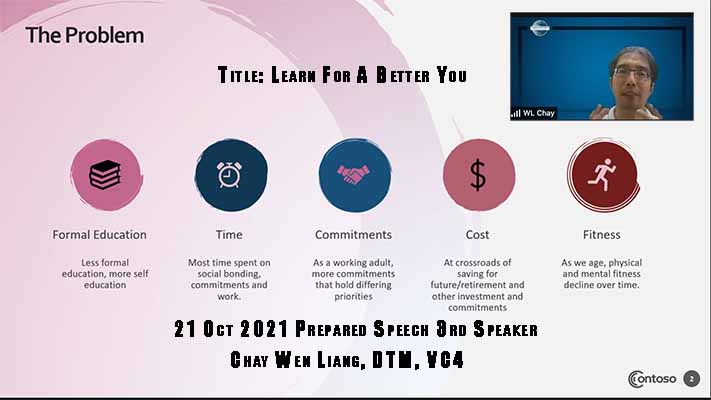
- Formal Education: less formal education ,more self education.
- Time: most time spent on social bonding, commitments and work.
- Commitments: As a working adult, more commitments that hold differing priorities.
- Cost: at crossroads of saving for future/retirement and other investment and commitments.
- Fitness: as we age, physical and mental fitness decline over time.
The Vision
The vision that Wen Liang has set out for himself in this project is to make learning a continuous, consistent, and regular process. A process that can be continued all the way till old age, not just for the duration of this year.
This comprises a mixture of targeted activities, and casual meetings. A casual curiosity about things like our hobbies and things that make us interested. Targeted meaning going for formalised education, having someone to teach you and guide you, helping to motivate you and to continue learning new things; especially in areas of work and in your personal life, particularly if you are planning on a career change.
Wen Liang will continue to tell us in his next text speech, on his plan, whereas in this speech, he is only developing this vision.
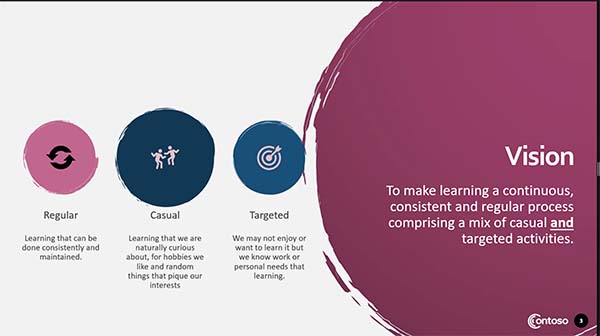
- Regular: learning that can be done consistently and maintained
- Casual: learning that we are naturally curious about, for hobbies we like and random things that pique our interest
- Targeted: we may not enjoy or want to learn it but we know work or personal needs that learning
A casual curiosity about things like our hobbies and things that make us interested. Targeted meaning going for formalised education, having someone to teach you and guide you, helping to motivate you and to continue learning new things; especially in areas of work and in your personal life, particularly if you are planning on a career change.
Wen Liang will continue to tell us in his next text speech, on his plan, whereas in this speech, he is only developing this vision.
Research
The first is research. There are so many resources for learning out there with technology nowadays, with zoom classes, online classes, e-books, audio books, courses offered on the internet by different organisations. After that having researched from what these areas, he will use them to formulate his goals and tasks towards the path and achieve that vision.
Support
Second is support. Support is important because if you do not share with the people around you that you are learning, then they do not know how you are doing. So it is important to share, and in fact, that you can find a time, a place, or an opportunity to implement what you learn. This will help you keep on learning and the feedback you receive will help give an idea of how you can improve further. It can also work towards motivating you and pushing you to do even better.
Attainable Goals
Lastly, the plan must be attainable. The goals he plans to set towards that vision would therefore have to be something that he can follow myself or each and every one of us throughout our lives to the later years. It is something that can be done year after year like a timetable, with a recurring schedule that we all know that we must achieve these kinds of things every year. Not just setting a new year resolution and most people just end up forgetting about the resolution and pushing it to next year.
Conclusion
In conclusion, Wen Liang reminded us that learning can be targeted with an objective in mind, not just about work, but also your personal growth, for self, and happiness.
Table Topics
After our break, we continued with our Table Topics session. The Table Topic Master is yours truly, Daniel Sun, CC. Following the last time I designed the Table Topics according to dramatic plots from movies and television series, I chose the theme, “Tell Me What Love Is!” for this chapter meeting’s Table Topic session. I took quotes from romantic movies, particularly I personally favoured like “My Sassy Girl”, “Il Mare”, “Windstruck” and some classics like “Love Story”.
Table Topics participants could choose to agree, disagree or comment on these quotes.
Owing to a shortage of prepared speeches for the evening, we had more speakers for Table Topics. The topics selected by our 7 speakers were as follow:
- There Are Three Things A Person Cannot Hide: Coughing, Poverty And Love. – Il Mare
- We Have To Stay Alive, Because We Have To See How The Story Ends.
- Love Means Never Having To Say You’re Sorry – Love Story
- Love Doesn’t Mean Giving Something Up For The Other Person, But It Means To Achieve Something. – It’s Okay, That’s Love
- We’re Tormented Because Love Goes On, Not Because It Goes Away. – Il Mare
- Once In Your Life, If You Are Very Lucky, You Will Meet The Person Who Divides It To The Time Before You Met Him/Her And The Time After. – My Sassy Girl
- Don’t Be So Sad Because Of Me. We Will Meet Again. When We Meet Again, Tell Me All The Memories You Experienced From This Life. – Windstruck
There Are Three Things A Person Cannot Hide: Coughing, Poverty And Love. – Il Mare
Speaker: Yoong Ee Chuan, ACB, CL, MS2
Ee Chuan took a contrary approach by agreeing with the statement.
He said that coughing can be hidden and particularly during this pandemic, coughing which can be infectious will alert people who are near to you. As for poverty, many people try to hide their poverty by dressing well and doing things that are inconsistent with their financial status.
As for love, he felt that love too can be hidden. Ee Chuan opined that the greater your ability to hide love, the better you can position yourself.
Maybe Ee Chuan believes in keeping an upper hand in a love relationship where the one who loves more have to submit and succumb to the one who is being loved.
Perhaps I should have quoted also the second statement that was in the movie, “Il Mare”. It goes this way: “the more you try to suppress them, the more they show up.” Recall those moments you tried to suppress your cough, eventually you burst out coughing even more vehemently?
“Il Mare” (2000) was a Korean movie acted by Leon Ji-Hyun, the lead actress of the movie “My Sassy Girl” (2001). Both movies were directed by Kwak Jae-Yong. Il Mare means “The Sea” in Italian. This movie was reproduced by Hollywood as “The Lake House”.
We Have To Stay Alive, Because We Have To See How The Story Ends. – My Sassy Girl
Speaker: Chay Wen Liang, DTM, VC4
“My Sassy Girl”, a great Korean romantic comedy that possibly started many Singaporeans on Korean movies. It is a classic piece of work.
Wen Liang said that we have memories that we can look back on because we were alive to share and engage in activities with people that we love and care about.
It is only when we are alive, that we can steer how each memory is created and to create memories, we have to make the effort to appreciate and engage those who are also alive.
So for the ones we love, we need to create more memories to look back on, but we have to be healthy and strong too. So that at the end of our own life story, the memories can be compiled into a thick novel that ends with a bang!
Love Means Never Having To Say You’re Sorry – Love Story
Speaker: Avinash Narasimhan, PM1
“Love Story” is a very old movie back in the year 1970. I believe most of us have never watched the movie. Somehow we all know the soundtrack and have come across this famous (but irrational) quote: “Love means never having to say you’re sorry.” If you want to catch this movie, you still can watch it on Netflix.
Avinash said that a relationship is built up with small things, small gestures and small actions that make those moments memorable. These little gestures and moments culminate to a larger effect and a larger scale of things.
However, when you make a small mistake like forgetting your fiancé’s birthday, your apology and the forgiveness that she bestows will not accumulate into a big disaster in the future.
Well Avinash, I am not sure if forgetting your fiancé’s birthday is regarded as a small mistake by her. Nevertheless, I believe many people will agree that in a relationship, it is important to apologise when you have made a mistake, particularly towards your boyfriends/girlfriends and spouses. Not doing so, it will certainly kill the relationship sooner or later.
I think the script writer of the movie, “Love Story” probably felt that the statement could bring a dramatic and memorable moment to the movie. However, it is irrational.
Love Doesn’t Mean Giving Something Up For The Other Person, But It Means To Achieve Something. – It’s Okay, That’s Love
Speaker: Jane Pang, CC, CL, VC3
Jane opened up her speech by saying that she will relate this to her personal experience. Wow! She made a quick U-turn by saying that this can be related to love for your parents and kids. Oh …
Jane continued by saying that if you love your kids, it does not mean that you have to give everything to them, or give up everything for them.
Jane went on to emphasised on Tough Love! She believes that delay gratification will help them to achieve greater things in life. She cite the example of not buying things like toys when children begin whining. Instead you have to teach that them attain certain standard and achieve something before rewarding them for what they want. They have to achieve before they gain something.
Jane, Jane, Jane, … That was very shrewd of you. You twisted the table topic from romantic love into parental love.
By the way, love between a couple can be tough too. I have watched movies where a person had to be tough with their spouse in order to help them get rid of their drug addiction.
We’re Tormented Because Love Goes On, Not Because It Goes Away. – Il Mare
Speaker: Triggi Chan, CC, IP1
Triggi began by quoting a Japanese saying, “The opposite of love is not hate but antipathy.”
She made a contrast of friends who behave badly, gossiping about everyone, etc. You could totally disregard them and stop caring about them. On the contrary, you could continue to care for them and try to show them the right path. Choosing this path to continue to care for them can be painful and hurtful.
Hmmm … Triggi, you attempted something like Jane did, you talked about friends instead of love in a romantic relationship. Anyway, love between any two parties involve efforts and sacrifice, and that hurts a lot.
Mahatma Gandhi read in the Bible that Jesus said, “Love your enemies.” He did that to the British, his colonial masters and hurt them to a point that drove them away from India.
Once In Your Life, If You Are Very Lucky, You Will Meet The Person Who Divides It To The Time Before You Met Him/Her And The Time After. – My Sassy Girl
Speaker: Annabelle Yong, DTM
Annabelle began by saying that she considers herself a romantic person in the sense that she likes to watch romantic movies and she likes to witness the “happily ever after” ending. That explains the fact why she does not like horror movies and movies that make her feel depressed.
She posited that the question is whether you can find someone who can give you that “happily ever after”. As a little girl, she grew up reading stories and watching movies about the knight in shining armour that rides on a white horse sweeping girls off their feet, dashes away together.
Annabelle got back into reality that such made to believe stories and movies might not be easily materialised. Thus, the moment we should find somebody that we can really talk to, relate to, and to have that connection with each other.
Annabelle even went further to say that she is fortunate to have found such a person. (Confession time! Never mind. She knows that everyone in Toastmasters knows about it and who it is. No deep secret or great revelation.)
She added the icing to the cake by saying that that someone could even say, “Sorry!” So she also addressed the Love Story movie’s quote, “Love means never having to say you’re sorry.” No, a thousand times no. Love does not mean never having to say you’re sorry, but you say sorry because you care enough for that person.
Annabelle then concluded by saying that if you are lucky enough to meet that someone who gives you his time, who cares for you, and willing to say sorry to you, that is someone you cherish.
Don’t Be So Sad Because Of Me. We Will Meet Again. When We Meet Again, Tell Me All The Memories You Experienced From This Life. – Windstruck
Speaker: Wekie Tay, DTM
Well, initially Annabelle was supposed to be the last Table Topic speaker. However, Elaine excitedly asked for one more speaker, Wekie, to speak too. I shall print his speech here in verbatim.
Whenever we go through life, we accumulate memories. Especially deep memories of people we are in love with, deeply affectionate towards. This is so important because it is built upon the past that helps us to drive towards the future.
I’m so glad when I am with someone in particular, I don’t feel sad. In fact, I am excited. I am always excited to build new memorise with her. Not just because of the past but what the future holds.
I am a person who keeps looking forward to the future knowing whatever is in the past will build the foundation for us to move happily towards the future. I love it too whenever she reminds me of the great times we had. Even for the sad times will always be great because of her.
Therefore the message is this: anything that is sad will always be better. If you care about someone, anything that is negative will always be meaningful. Most of all if you care about that person with love, your future will always be romantic, filled with love, worth treasuring and worth sacrificing. I hope you find the people you love for now, the past and future.
This quote is taken from the Korean movie, “Windstruck”. Again, Windstruck is a combination of romance, comedy and tragedy Korean movie acted by the same actress and directed by the same director of the movie, “My Sassy Girl” and “Il Mare”. It was somewhat a prequel of “My Sassy Girl” after it became a big hit in Asia.
Beat Speakers
Best Speaker (Prepared Speech)
Chay Wen Liang, DTM, VC4
Best Table Topic Speaker
Wekie Tay, DTM
Best Evaluator
Wekie Tay, DTM
President’s Closing Address
The President’s Closing Address was delivered by Avinash Narasimhan, PM1, President of Telok Blangah Toastmasters Club.
Avinash affirmed that the meeting had quite a number of good speeches particularly during the Table Topic session. He also thanked Triggi for being the Toastmaster of the Evening for the “first time” and complimented her for handling the ongoing of the meeting well. (Perhaps Avinash, this was the first time you had come across Triggi being the Toastmaster of the Evening but it was certainly not her first although it is not frequent.)
Finally, Avinash echoed Elaine’s Opening Address in calling everyone to participate actively in forthcoming chapter meetings as speakers and appointment holders as the year draws to an end.
Upcoming Event
The Open Alumni Toastmasters Club will be conducting its SpeechCraft Workshop 2022 on the following dates:
- 24 February 2022
- 3 March 2022
- 10 March 2022
- 17 March 2022
Each session will be held from 7:45 p.m. to 9.50 p.m. Registration fee will be S$90/pax for single sign-up and at a discounted rate of S$70/pax for double sign-up. Those who are interested, please register with Yoong Ee Chuan, ACB, CL, MS2.
Visiting Toastmasters
Yip Li Xian, ACB, CL, Area Z1 Director, NUS Toastmasters Club


0 Comments